Decluttering Checklist for a Calmer Entryway in a Small UK Home
Decluttering Checklist for a Calmer Entryway in a Small UK Home
The hallway is the hardest-working space in a small home, and usually the last to get any attention. It takes in coats, wet shoes, unopened post, school bags and a screwdriver that has sat on the windowsill since March. In a Victorian terrace or a modest 1930s semi, that hallway might be barely a metre wide, with a radiator on one side and a front door that swings straight into a row of coat hooks. It is a corridor, a cloakroom, a letterbox and a launch pad, all crammed into a space you can cross in four steps.
That is exactly why it goes wrong. Every other room in the house has one job; the hallway has five. And because nobody sits in it, nobody notices the slow creep of clutter until you are edging sideways past a tower of trainers to answer the door. The good news is that an entryway needs far less than you think. Here is a calm, realistic checklist you can work through in an afternoon, plus a few habits that keep it that way.
Why the hallway gets so bad (and why it isn't your fault)
Entryway clutter is rarely about laziness. It is about friction. If the hooks are full, coats land on the bannister. If there is no shoe tray, wet trainers go on the floor by the radiator. If it is raining and the recycling box lives outside, the post goes on the stairs "just for now". Every item that lacks a home will find one of its own, and it will usually be the floor.
In small UK homes there is a second problem: the front door often opens directly into the living space. There is no porch, no boot room, no transition zone. Everything from the outside world — grit, leaflets, receipts, the dog's lead — arrives straight into the middle of the house. So the aim is not to make the hallway empty or styled. It is to make it fast: everything in and out in seconds, with one clear place for each thing.
The Decluttering Checklist
Work through these steps in order. Resist the temptation to skip to the fun part (buying baskets) before you have done the boring part (taking everything out).
1. Set a timer and clear the deck
Give yourself twenty minutes. Take everything that is not furniture out of the hallway and put it on a sheet or a table in the next room. Coats, shoes, bags, post, keys, dog leads, umbrellas, the mystery screwdriver. All of it. Seeing the space completely empty is oddly motivating, and it also shows you exactly how much room you actually have to work with.
2. Sort into four piles
Not "keep" and "chuck". Four piles, because the middle ground is where clutter quietly lives.
- Belongs here — worn this week, used daily, genuinely essential.
- Belongs elsewhere — the screwdriver, the birthday cards, the returns parcel, the library book.
- Belongs to someone else — charity shop, a friend, school lost property, the recycling bin.
- Broken, damp or never used — the leaking umbrella, the single glove, the shoes that hurt.
3. Deal with the "belongs elsewhere" pile immediately
This is the step most people skip, and it is the one that matters most. Put the screwdriver back in the toolbox. Take the parcel to the post office. Return the library book. If you leave that pile in a bag by the door, you have simply created a tidier version of the same problem. Set yourself a rule: anything in this pile leaves the house within 24 hours.
4. Clean the empty space
Wipe the skirting boards, hoover the corners, wash the floor. Hallways collect grit from outside, and it is astonishing how much brighter a narrow space looks once the floor is clean. If you have a coir or rubber mat, beat it outside; if it curls at the corners, replace it. A mat that will not lie flat is a trip hazard in a corridor you cross in the dark.
5. Put back only what earns its place
Now bring things back one at a time. If you hesitate, it does not go back. The test is simple: have I used this in the last two weeks, and would I miss it if it vanished? Everything that passes goes into a designated spot. Everything that fails returns to its pile.
What actually earns a place in a small hallway
- One coat per person, plus one waterproof or "rough" coat. Not four.
- Shoes currently in rotation — typically two pairs per person, maximum.
- A bag each — school bag, work bag, reusable shopping bag.
- Keys on a hook near the door, high enough to be out of reach of small children.
- One umbrella that works, rather than a broken trio.
- A post tray or wall file, with a rule that it gets emptied weekly.
- Dog lead, poo bags and one spare towel, if you have a dog.
That is it. Everything else — spare coats, out-of-season shoes, wellies, the random screwdriver — belongs in a bedroom cupboard, under the stairs, or in a labelled box on top of a wardrobe.
Small-space storage that actually works
You do not need much, and you do not need to spend a fortune. In a narrow hall, vertical space is your friend and floor space is the enemy.
- Hooks at two heights — adult hooks around 1.7m, children's hooks around 1.1m, so small people can hang up their own things.
- A shallow shoe rack or two-tier tray — depth matters more than width. Measure the gap behind the door before you buy.
- An over-door hook rack for bags and leads, if the door frame allows it.
- A wall-mounted post file or slim basket to keep paper off the stairs.
- An under-stairs cupboard treated as a proper cloakroom: hooks inside the door, a box per person, a shelf for wellies.
- A small lidded box for out-the-door items — returns, letters, things to drop off on the school run.
"A hallway isn't tidy because everything is put away. It's tidy because there's nothing in it that shouldn't be there in the first place."
The two-minute reset and the ten-minute weekly sort
Decluttering is a one-off; staying decluttered is a habit. Two small routines do most of the work.
- The two-minute reset, every evening. Coats on hooks, shoes in the tray, post in the file, keys on the hook. Everyone in the house does their own. It takes less time than hunting for your keys in the morning.
- The ten-minute Sunday sort. Empty the post file, take the out-the-door box to the car, and check for anything that has crept in — a stray mug, a toy, a receipt, a single glove. Bin it or move it. Ten minutes, once a week.
If you only adopt one habit, make it the post file. Paper is the fastest way a small hallway fills up, and it is also the easiest thing to control, because it arrives on a predictable schedule.
Where to take the things you've removed
Getting the bags out of the house is half the battle, so have a plan before you start.
- Charity shops take clean, wearable clothing and paired shoes. Ring ahead — many small shops have limited storage.
- Textile and shoe banks in supermarket car parks accept worn-out items too, which are recycled rather than resold.
- Your local household recycling centre takes broken umbrellas, battered shoes and small electricals.
- Facebook Marketplace, Freecycle or Olio for usable furniture and bulky items — a shoe rack or set of hooks usually goes within a day.
- School lost property and the nursery for the small coats and pumps that no longer fit.
Common mistakes to avoid
- Buying storage before you declutter. You will only end up buying containers for things you do not need.
- Storing out-of-season coats in the hall. A winter coat in July takes up prime space for no reason at all.
- Keeping "just in case" shoes. If they hurt, they hurt. Someone else will wear them.
- Letting the hallway become a holding pen. Things waiting to go upstairs should go upstairs today, not next weekend.
- Ignoring the door swing. Measure before you install anything, or you will be dodging a shoe rack every time you come home.
The end result
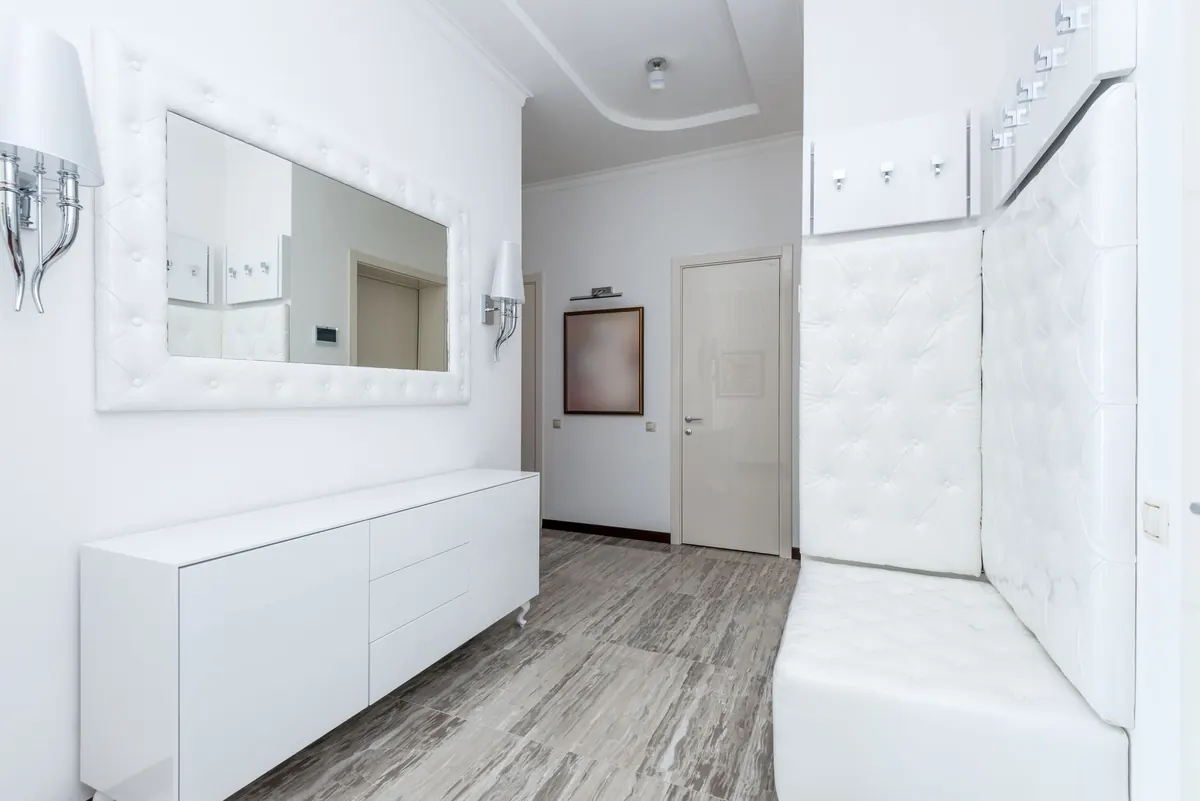
None of this requires a bigger house, a joiner or a weekend of DIY. It requires an empty afternoon, a few bags, and a rule that the hallway is a corridor, not a cupboard. When you walk in with wet shoes and a handful of post, you should be able to hang, drop and step through in under ten seconds. That is what a calm entryway actually feels like — not styled, just easy. And in a small UK home, easy is the whole point.
Photo: Max Vakhtbovych / Pexels